Showing posts with label Shetland. Show all posts

Monday, 7 January 2019

Polkagris Kerchief


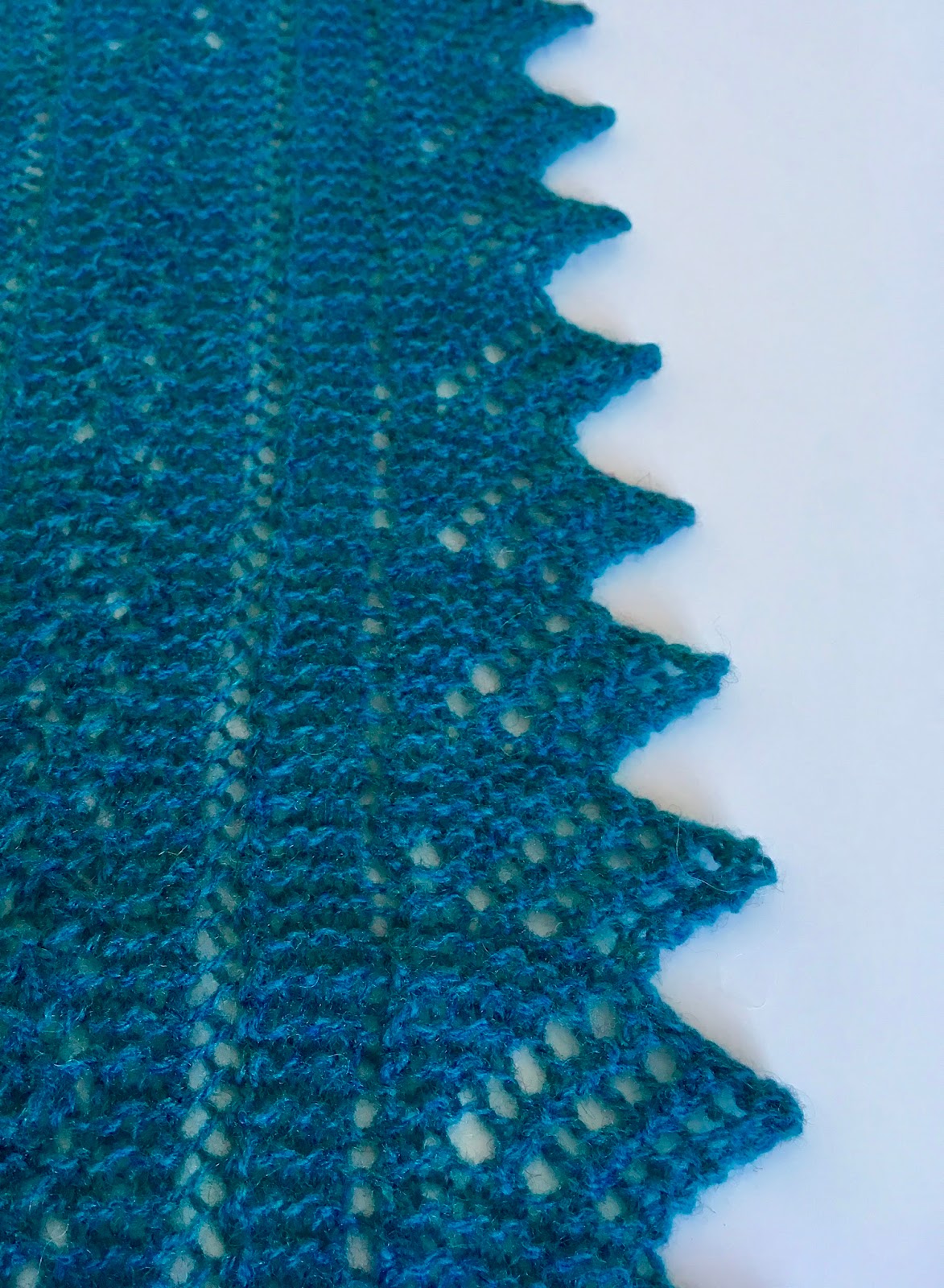
The Polkagris Kerchief is a lovely, quick and simple knit by the designer Kate Davies

I used a set of two mini skeins of sport weight, spun from Shetland sheep fleece. One a natural white and the other naturally dyed over marl grey in shade "Ocean".

Now, this was no ordinary Shetland yarn, it was a blend of wool from Shetland sheep originating from 4 farms near my croft in Scotland. When I dispersed my flock of Shetland sheep a couple of years ago the ewes went to live at one of those 4 farms. So, when I discovered that Julie from Black Isle Yarns had acquired fleeces from sheep which used to belong to me, I was keen to buy some yarn and see how it had turned out. 


Here's an image from 2012 with some of my Shetland ewes.


These are the mini skeins from Black Isle Yarns, 40g each. I love the green shade dyed over the grey giving the marl look. The are both very soft and have a rustic look. 


I used a 4mm small circular needle for this knit project. The garter stitch mini shawl is cast on at the centre back. Then increases are made to create an elongated triangle. 


To make the shawl slightly larger I knit some extra rows in grey and mustard in Buachaille yarn


I'm really pleased how this project turned out especially as I had in mind to gift it to a friend for her birthday.


Of course, I just had to take a picture of this kerchief with the view, over looking the fields where my sheep used to graze. 


Wednesday, 13 June 2018

Visitors from Scotland


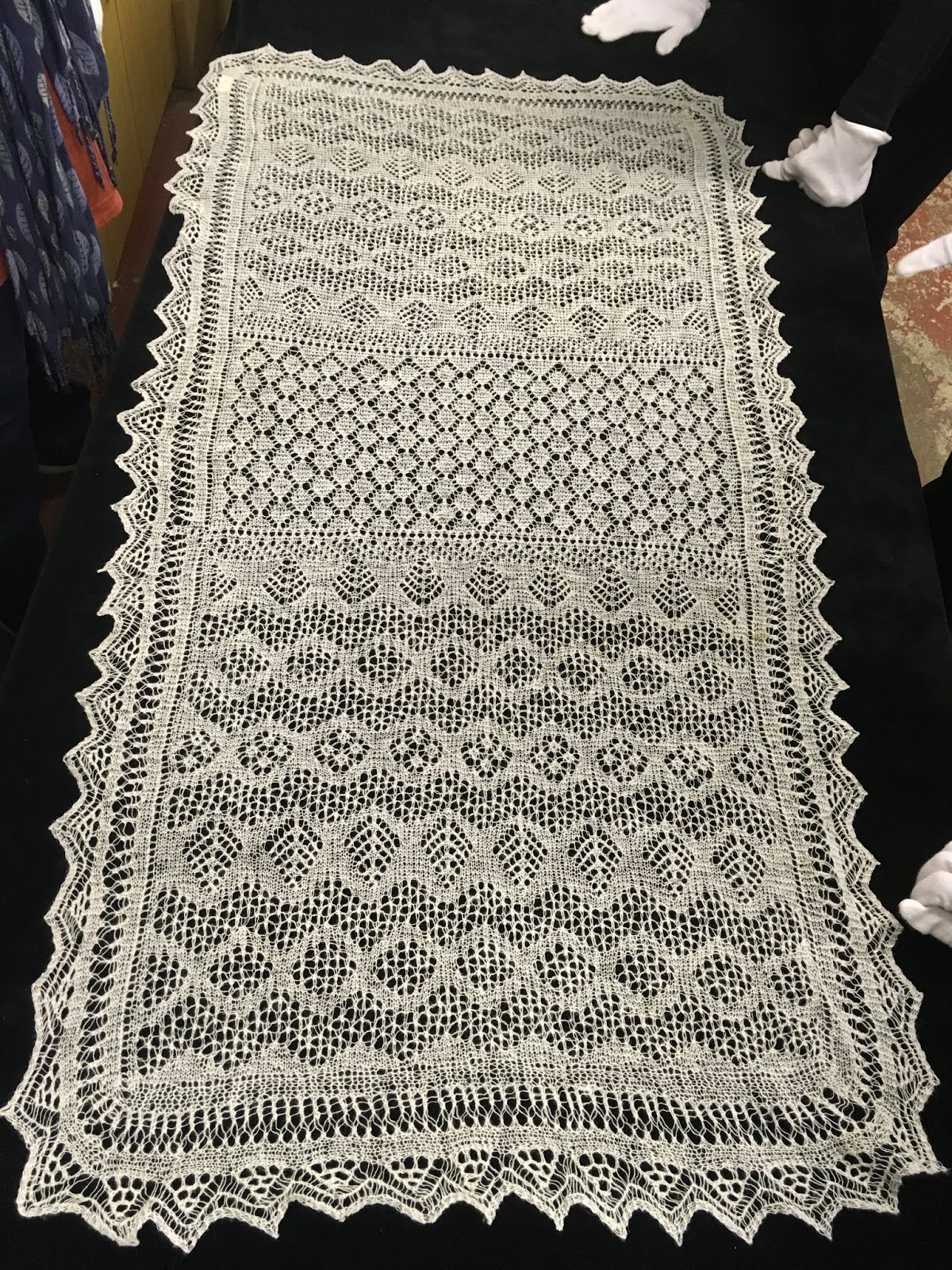
Last week the Knitting and Crochet Guild Archive (KCG) in West Yorkshire welcomed some visitors all the way from Scotland, Carol Christiansen, Shetland Museum curator and Roslyn Chapman from Glasgow University. The KCG archive holds an enviable collection of hand knitted "Shetland" lace shawls. Some of the most interesting and delicate examples had been selected in advance to show the visitors. 

First on the morning agenda customary, tea, coffee and biscuits in the office and a chance to discuss the archive in general.


Carol and Roslyn outlined the purpose of their visit which related to research started in 2016.  It centres around the traditions of Shetland lace knitting, cultural implications, branding and the marketing of "authentic" Shetland knitwear. 

Filmed and broadcast live, a study day held in 2016 about the research gives an overview of the project. The recording can be see here or by clicking on the image below. Background information to this film can be found here on the Shetland Museums website.


Following our refreshments we relocated to the main archive. Much discussion and information was exchanged around each knitted item displayed. Carol and Roslyn shared their in depth knowledge of Shetland lace shawls, haps and garment construction, along with insights on authenticity.  

Members of the KCG team shared information on the history and provenance of items in the collection. Much discussion followed which I haven't included here, but the following images hopefully give a snapshot of some of the lace knitting the team had prepared for the visitors.


The above images show two good examples of large shawl/haps with the knitting pattern for both shown below.


Knitting pattern books dating from the 1800's are held by the KCG archive.  The Edinburgh based author Jane Gaugain wrote extensively on "Shetland" lace knitting. A blog post by Kate Davies  "In the steps of Jane Gaugain" gives an insight into this prolific pattern writer.


Going off-piste at the end of the day, some knitted treats from the archive were retrieved to show the visitors. Three lovely examples of children's Fair Isle jumpers dating from the 1930's to 1950's.


Then some excellent examples of Bohus knitting from the collection. (I wrote a little piece about this style in an earlier blog post here).


And finally the group photo, (unfortunately some of the team had to leave early and are missing from the photo). 
From left to right Trish, Julia, Barbara, Ruth, Carol and Angharad.

Following a very informative and interesting day our visitors left for the long trip back north.

Wednesday, 31 January 2018

Shetland Lace Knitting


While browsing publications for instructions on lace shawl knitting I came across The Magic of Shetland Lace by Elizabeth Lovick. The  cover indicates the contents include stitches, techniques and projects for lighter than air shawls, just what I was looking for! However, it was the image on the front depicting light difused, delicate lace samples which inspired me to take a closer look inside. 

The book has a stitch directory of essential Shetland lace knitting patterns. These are arranged into four categories: insertions, motifs,  allover patterns and laces.  I particularly like the samples in pastel colours which are photographed on a white background. The directory shows all the samples side by side so you can make comparisons. Each sample is referenced with the number of stitches and a row count. There are charts and written instructions for each design along with a larger image. There's also a "concentration level" guide, from 1 to 3 for each pattern (3 requiring the most concentration).


If you can knit and purl, do yarn overs and knit two togethers, this book claims to show you that Shetland lace knitting is with in your reach.

A very detailed chapter on how to put together a shawl design with helpful guidelines and practical examples gave me the confidence to try this myself.


The yarn I chose was, Jamieson's of Shetland Ultra, (x5, 25g balls shade Waterlily #690) knitted with Knit Pro Symfonie Rose Cubics size 4mm needles. The needles have a square cross section and are supposed to be ergonomically designed for a comfortable grip and produce more even stitches. They were easy to use except the dark rose wood colour, which combined with the dark shade of yarn I had chosen made seeing the stitches clearly more difficult. Once started I persevered, suspecting a change of needles part way through may have altered my knitting tension. Something I need to to bear in mind for the future.


The following is a description of the shawl I knitted along with  the selection of stitches I used from the book. There's no coincidence that they all require the lowest level 1 category of concentration. That said, it was a project I needed to give my whole attention without distractions.


There are 20 edging patterns. Attracted by the word "easiest", I chose Brand Iron Lace for the edging. Described as, "a common, old lace pattern... which works well in any yarn" It's worked over 12 stitches and includes, yarn overs, knit two togethers, cast off stitches. It's not difficult, the crucial thing is to keep count of the rows to maintain the pattern, the effect is quite striking and just as effective as some of the more complex edges requiring more concentration.


Two types of insertion were used, "Ladder" and "Bead" from the total of 13 described. 


Next, the central panel uses an allover pattern called, "Fir Cone". This is worked over 10 stitches and 20 rows. It includes the instruction, knit three through the back loop, (k3tbl) and is much easier than it sounds.

Then, the previously mentioned insertions and edging are repeated on the other side.

While I chose the easiest patterns I liked from the book, the actual knitting required considerable concentration. Several errors remain, unfortunately, uncorrected after being discovered well after the event. 

I'd certainly like to have a go at some of the more challenging stitch patterns but perhaps next time reduce the number of different elements which might help reduce the number of mistakes (and the length of time to complete it). 


Tuesday, 15 March 2016

Dovestone Smallholding Knitted Shetland Pony


This knitted character is "Shetland Pony" from Dovestone Smallholding by Ella Austin. The pattern book is available from Ravelry as a digital eBook or as a printed edition from Baa Ram Ewe. The collection features 7 toy patterns and a play mat made with Titus DK Dovestone yarn from Baa Ram Ewe in Leeds, West Yorkshire.


After receiving a copy of the eBook from Ella and browsing the designs I knew I'd have to make at least one of the cute and irresistible characters. As I'm a fan of most things "Shetland" it became obvious  it had to be the "Shetland Pony". The other toys are Lucy Doll, Dabbling Duck, Fancy Hen, Plum Pudding Pig, Wensleydale Lamb, Moggy the cat and the Hedgerow play mat.

Dovestone Smallholding Image copyright Baa Ram Ewe used with permission

Dovestone Smallholding Image copyright Baa Ram Ewe used with permission
Dovestone Smallholding Shetland Pony Image copyright Baa Ram Ewe used with permission

The pony pattern uses two colours. In the book it's grey for the main colour and a contrast of blue for the mane and pattern detail. Checking my stock of yarn I had just enough Debbie Bliss Bluefaced Leicester DK, in Grey and Burnt Orange and decided to put this to good use. The recommended needles are 3mm long dpn's. 


The instructions are very detailed, nicely laid out with lots of close up images of the finished items. I found the knitting relatively easy. There are a few technical skills required for the pony such as working with two colours of yarn, also grafting stitches and the book includes details. A 'cable cast on' was recommended for the pony legs. A new one for me and it has nothing to do with cables. The instructions are not in the book but a quick search online brought up a number of tutorials including a video. It's a very useful technique for creating a cast on edge which is not too tight and stretches. You start with a slip knot and use the working yarn to make the stitches, avoiding the need to measure out yarn in advance to cast on as in the long tail method.

Pony turned out slightly larger than I thought but that was probably more to do with my knitting than anything else. The best part was completing the knitting stage and putting him together. I found some heart shaped wooden buttons for the eyes. Wasn't too sure these would work but once I had them in position he really came to life, so to speak. 

Just for the photos I made a "stable" for him but in reality he'll be sitting inside on the sofa....